Images: Duncan Craig; homepage - GTWS/Koastal Forest
Runner’s World | August 2026
‘It’s something you have to live to understand’
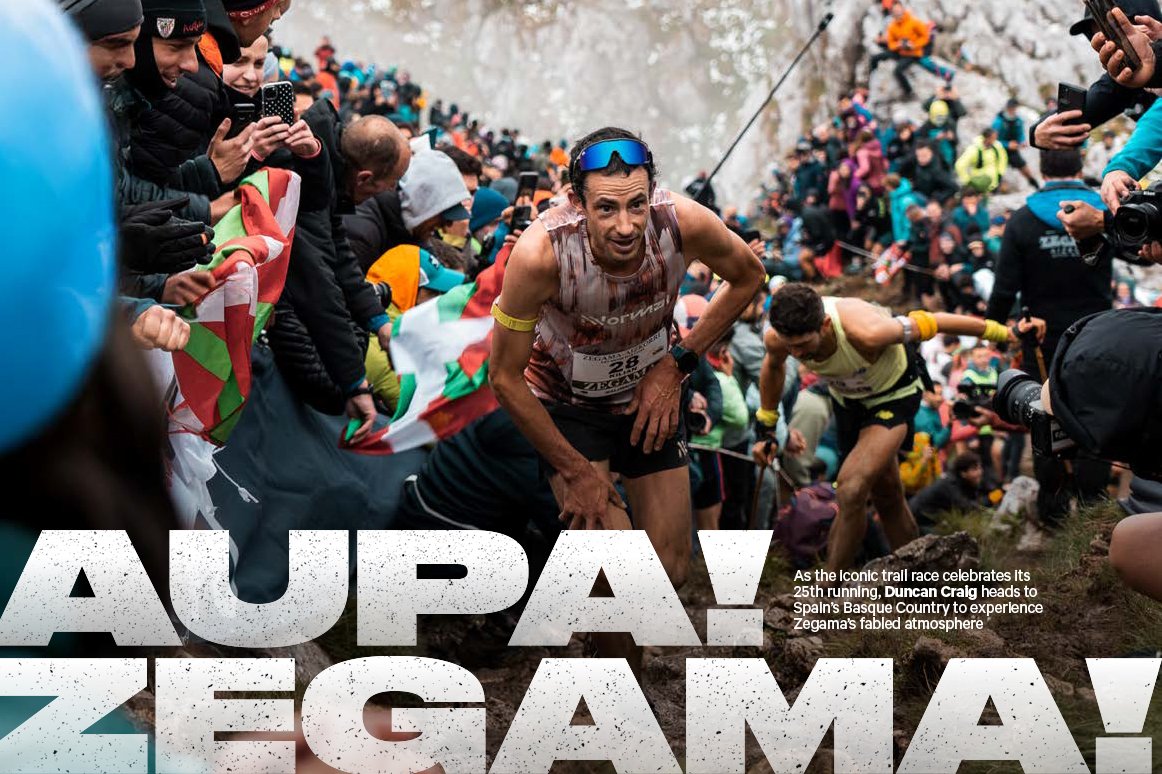
As Zegama celebrates its 25th anniversary, Duncan Craig heads to the Basque Country to experience the cult race’s fabled atmosphere
It’s a Saturday evening in mid-May and in the open-sided sports hall of Zegama school the temperature is rising with the anticipation. Several thousand fans are packed inside, with hundreds more clinging to the railings or peering in from precarious spots on the steep grass bank behind.
A man whose grey hair and beard suggest he’s old enough to know better has some newly purchased Zegama-branded Salomon socks and he’s pulling the tag off and stretching them out in readiness for a signature. A trio of giggling girls, barely five years old, form a human chain and push guiltily to the front, their cheerful chutzpah rewarded with a prime spot beneath the stage and giant screen.
Fifteen minutes becomes 20, then 25. Still more fans arrive. It’s getting oppressive now, the concept of personal space long-since abandoned. Just as the discomfort threatens to become too much, pounding music fills the hall and the ring walks – or rather ring runs – begin.
With the syllable-stretching bombast of a boxing announcer, the MC introduces each of the world’s best trail runners in turn, and they jog down a cordoned-off tunnel through the crowd to the stage to be presented with their race bibs.
There’s exuberant local girl Sara Alonso, from nearby San Sebastián, whose win last year was followed by 48 hours of partying in a town that saves up all its hedonism for this one weekend. Other big names include affable Red Bull athlete Rémi Bonnet, popular Moroccan defending champion Elhousine Elazzaoui and Swedish prodigy Tove Alexandersson – a world champion in six different sports and the custodian of a gathering aura, even among her fellow pros.
Nearly 20 appear in total, all cheered fervently. But there’s little doubt who 95% of the people assembled here have come to see.
“Kilian! Kilian!”
A deep, sonorous chant consumes the hall. The music cranks up. There’s a carefully orchestrated pause and then the chosen one is passing among us: diminutive frame, beatific smile – gliding through the adoring crowd with the ease in which he’s tamed the hallowed course that begins and ends in this Basque Highlands town for nearly two decades.
Eleven wins in 12 attempts – and a scarcely fathomable 3:36.40 record for a marathon laden with 5,472m of elevation change – has seen him build the race’s legend as it, in turn, has gilded his. Absent last year, the 38-year-old is back. And, as he knows only too well, the raucous human corridor through which he now passes is just a gentle precursor to what awaits him and his fellow runners in the mountains tomorrow.
//
Standing bemused and unnoticed among the horde is 51-year-old Rob Jebb. He’s wearing an olive-green puffer jacket, tracksuit bottoms tucked into his socks and his closely cropped hair is streaked with grey. Jebb comes from an era not of slick choreography and hero-worship but of flasks of tea and car-park starts. Pre-race build-up in his day was something you got a cream for.
But make no mistake: the tall Yorkshireman is every bit the equal of these athletes, or at least he was. He won Zegama in 2005 and was six seconds away from a second title in 2006. He was the first person to break four hours for this mercilessly unyielding course and it took the man who’s tantamount to a living saint in these parts seven victories before he bettered Jebb’s 3:54.18. In the mythologising of Zegama, a little lauded fact, that.