
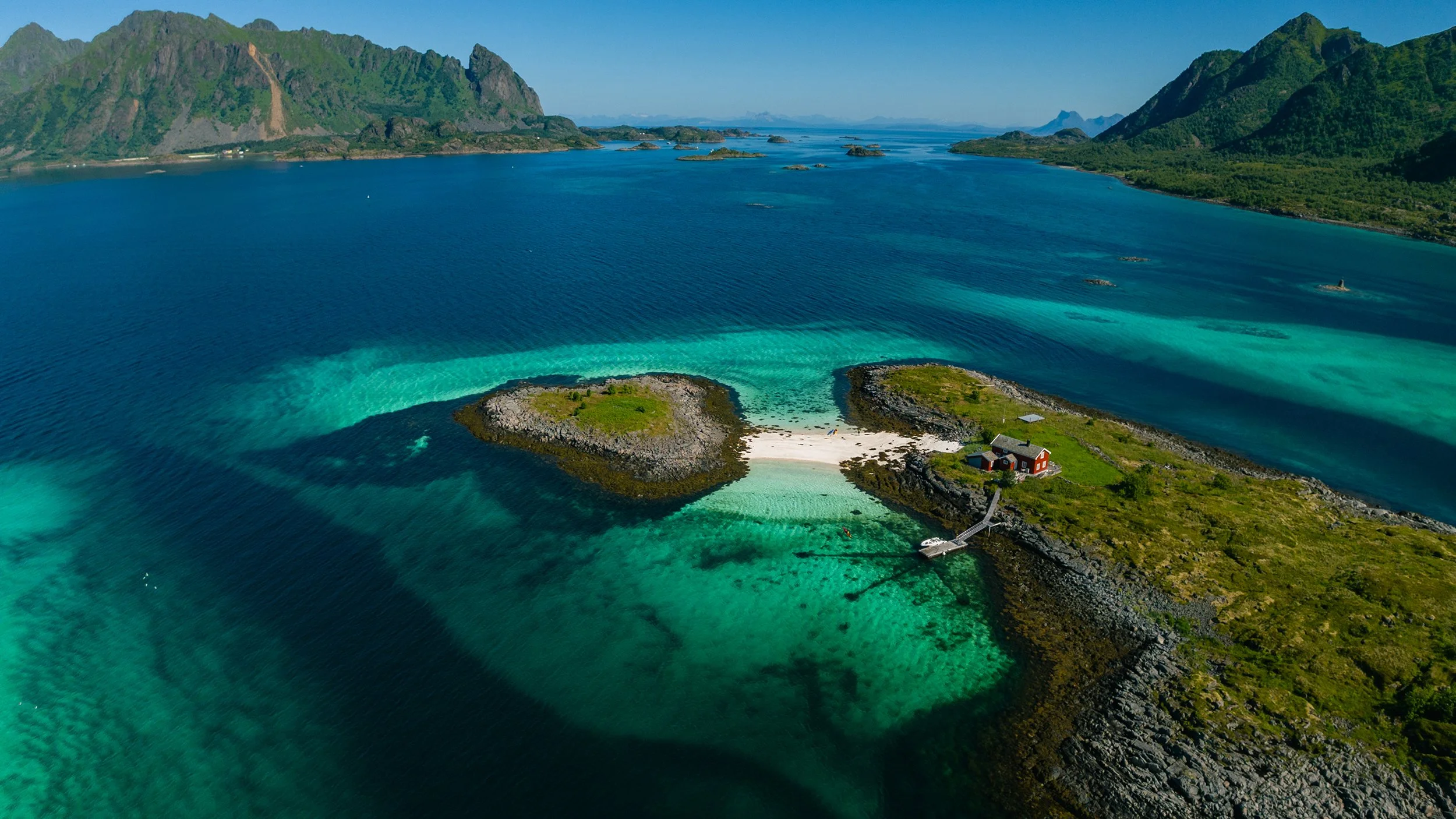
Images: Scott Salt
National Geographic Traveller | December 2024
Adrift in the Arctic Circle
Channel your inner Viking on a multi-day kayaking expedition through Norway’s Lofoten islands
Viking chieftains in Norway’s most sought-after archipelago had a novel way of ensuring their gatherings passed off without the customary bloodshed. Swords were left on one island, shields on another, with the power talks themselves staged on a third landmass, broadly equidistant between the two.
That this is being explained to me with the trio of islands within eyeshot, and by a man with a robust resemblance to a Viking warrior, lends the point a splendid indelibility. With his imposing bulk and long russet beard, one could well imagine Vidar Hansen riding the prow of an advancing longship brandishing a double-edged sword and unleashing the odd ice-meltingly fearsome roar.
Alas, today the guide is wielding nothing more offensive than a kayak paddle, and the only pillaging on his mind is the snack bag stowed in the little hatch just behind his seat.
We’re on a four-day kayaking expedition in the Lofoten Islands, a destination that — as those Vikings knew only too well — is tailor-made for seafarers. This ostentatiously proportioned island chain probes nearly 100 miles into the Norwegian Sea: a bafflingly intricate network of inlets, skerries, natural harbours and gargantuan monoliths partitioned by abyssal depths. Through these slender channels, the longships that once terrorised the North Atlantic as far afield as today’s Nova Scotia manoeuvred with skill and (fratricidal bloodletting aside) impunity.
Setting off from the teeny settlement of Tennstrand — an hour’s drive from the islands’ unofficial capital, Svolvær — we’re following a 25-mile, broadly north east to south west trajectory. The area is what’s known as the ‘inside’ of Lofoten: the southern flanks that face the mainland, sheltered from the full force of the Arctic currents and storms from the north.
You might say we’re island-hopping, though that would be to bestow on our enterprise a dynamism that’s conspicuously lacking. Our progress is slow, serene even — inspired by tranquil, sunny weather and the wonderfully pacifying effects of 24-hour daylight. When the sun’s in no rush, why on earth should we be?
Our craft — highly stable, and easily up to the odd skirmish with a recalcitrant rock — are packed with sufficient water and snacks to survive an Arctic winter. I’m quickly reminded of the inestimable joys of ‘the bicycle of the ocean’, as kayaks are known in these parts: nimble enough to probe even the tightest channel, yet sufficiently sleek to tick off multiple, largely effortless miles a day. We’re low profile, in both senses — doing nothing to intrude on a silence so comprehensive it’s almost disquieting.
