
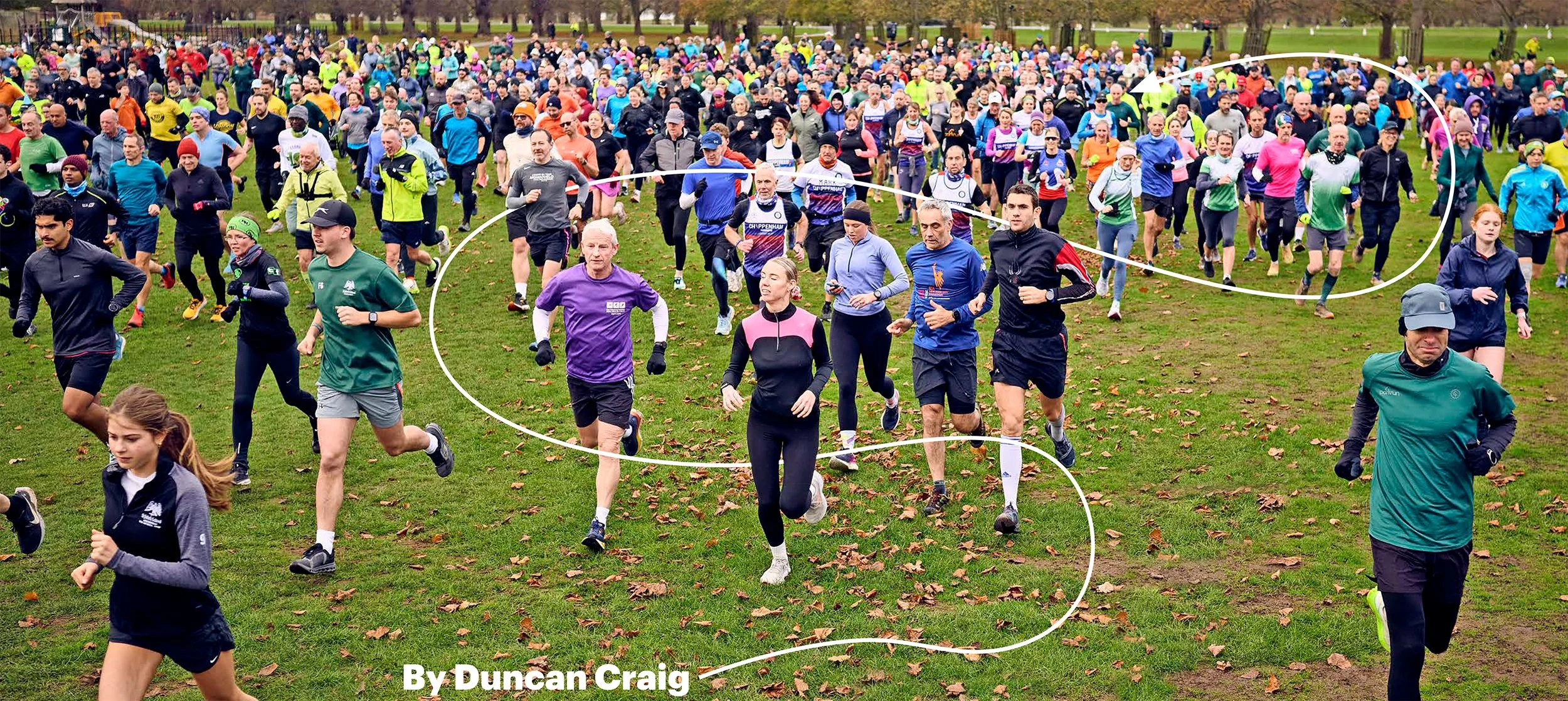
Images: Paul Stuart
Sunday Times Magazine | January 2026
They had an idea, and they ran with it
How a 5km fun run became an unexpected public-health triumph
More than four stone overweight and dressed in his paint-splashed DIY trousers and an old shirt, Hussain Al-Zubaidi tentatively lined up with the other runners in a park in Leamington Spa, Warwickshire.
A sedentary lifestyle, wayward diet and the stress of work had left the 26-year-old dangerously out of shape, as a few colleagues had gently pointed out. They knew what they were talking about; like him, they were junior doctors.
It was 2016, and the event was his local Parkrun — the free-to-enter, weekly 5km community run staged by volunteers, which has become a phenomenon around the world. By this point, Parkrun was more than a decade old. The doctors were regular attendees and had urged Al-Zubaidi to join them. Digging the closest thing he had to sportswear out of his cupboard, he’d agreed.
“The first 400 metres I felt amazing,” he recalls. “The next 4,600 metres were like hell on earth.”
Nevertheless he was hooked. The volunteers were supportive. The runners were cheerfully non-judgmental. And the dose of fresh air, exercise and sociability — what regulars call the “Parkrun pill” — coursed through his system. Several of his patients came over to say how pleased they were to see him there. “I felt embarrassed at first. But they were so nice. They just said, ‘Keep at it — you’ll feel stronger, you’ll feel better.’ ” So he did. And he does.
A decade on, Al-Zubaidi is an accomplished endurance athlete and heads up the Royal College of General Practitioners (RCGP) campaign for surgeries to “socially prescribe” Parkrun to patients. He has a personal best of 16 minutes 16 seconds, which puts him in the fastest 1 per cent of the world’s 7.7 million Parkrun finishers to date.
Not that he’s fussed about such things, he insists — echoing the movement’s mantra “It’s a run, not a race”. Performance, the ethos goes, comes a distant second to the transformative lifestyle benefits.
“Parkrun didn’t fix everything but it sort of switched on something in my head to make me realise that I had to start looking after my health,” Al-Zubaidi says. “And I quickly went from being someone who used Parkrun to help me, to someone who wanted to use it to help others.”
Like Al-Zubaidi, Parkrun had a hesitant start. Just 13 runners attended the first event organised by Paul Sinton-Hewitt, a Zimbabwe-born IT consultant and former marathon runner, on a misty morning in Bushy Park, Teddington, in October 2004.
By 2010 there were more than 50 events. By 2014, its ten-year anniversary, the tally was 471 across nine countries. Today it’s five times that, with Parkruns now being held everywhere from Eastbourne to Eswatini, Falkirk to the Falklands.
To date, 11.5 million people in 23 countries have registered on the Parkrun website and well over 100 million “participations” have been recorded. Some 850,000 first-timers attended a Parkrun event in 2025, 120,000 of whom described themselves as “completely inactive” prior.
The UK is its biggest “territory” and it’s here that the health benefits have been most pronounced. With nearly 6,542,000 registrations in the UK, getting on for a tenth of the population, the value to the NHS is huge. A 2024 study led by Professor Steve Haake at Sheffield Hallam University put this at £667 million a year — as a result of Parkrunners requiring less clinical care and seeing greater improvement in their medical issues (one in four Parkrunners has a health condition). Even offenders are benefiting — Parkruns have been held in prisons since 2017.
So how did Parkrun become one of Britain’s most successful public health initiatives? Probably precisely because it didn’t start out as one.
The man behind it all is limbering up in front of me on a chilly winter morning in Bushy Park, where it all began nearly 22 years ago. Sinton-Hewitt, 65, has a grey beard, broad smile and a lean frame that looks even leaner in his black jogging tights, maroon beanie and a “500” milestone Parkrun T-shirt (he just ran his 600th on Christmas Day).
Parkrun was born, in part, out of his own mental health crisis. “I was really struggling,” Sinton-Hewitt recalls. “I’ve always suffered with mental health issues. I’m not chronic but I struggle around circumstances, the way I was brought up…”
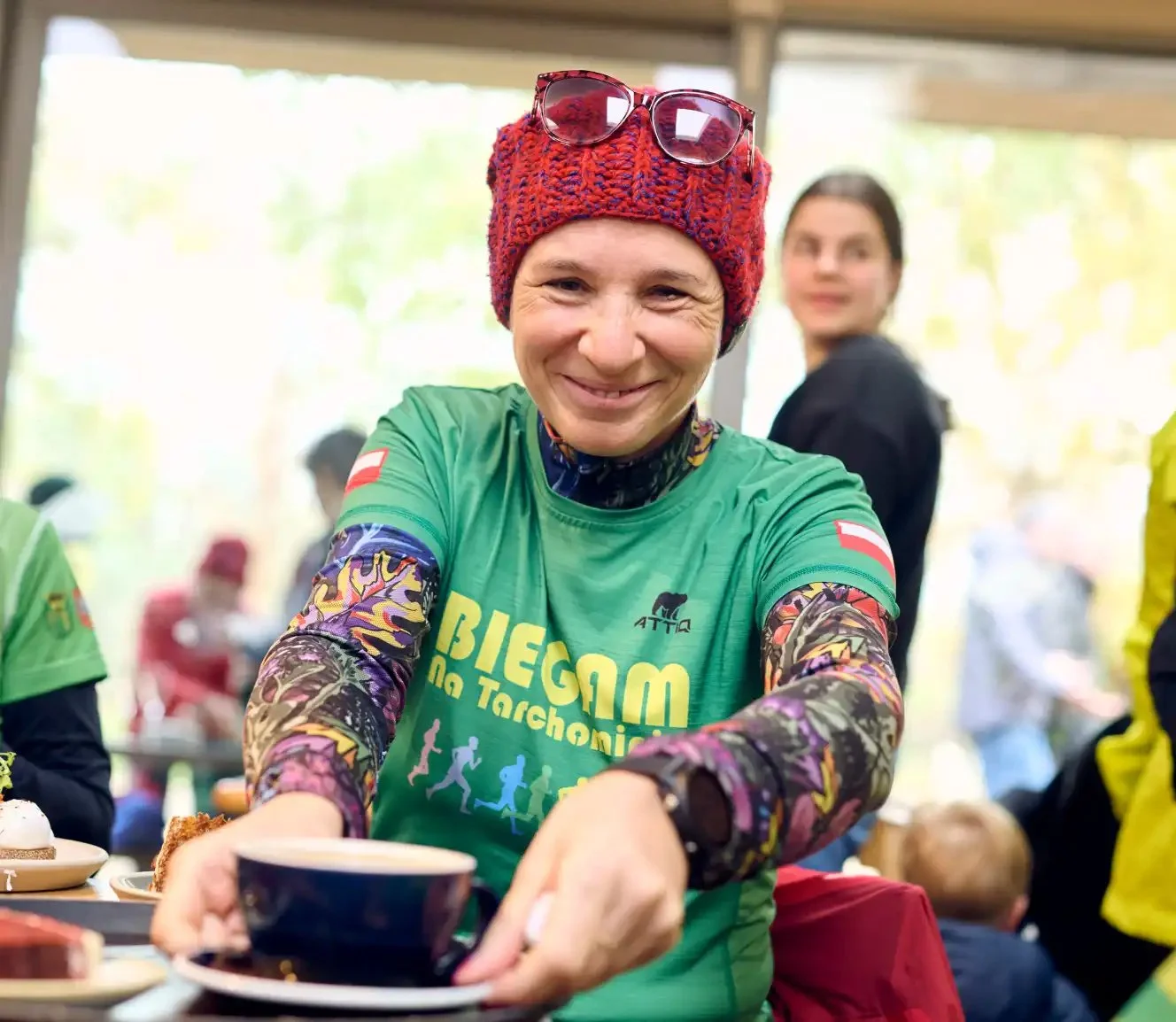
Paul Stuart