Images: Francesco LastrucciNational Geographic Traveller | April 2025
Higher calling
Meteora combines outlandish topography and improbable architecture to divine effect
As the sun sinks towards the serrated horizon of the distant Pindus Mountains, the assembled congregation grows quiet. There are perhaps 40 people gathered here, each occupying their own smooth knuckle of the lofty outcrop. Some have been present an hour or more, watching the day slowly drain from this extraordinary landscape. Others, such as myself, a matter of minutes – fortuitously passing Meteora’s most celebrated sunset spot as dusk closes in.
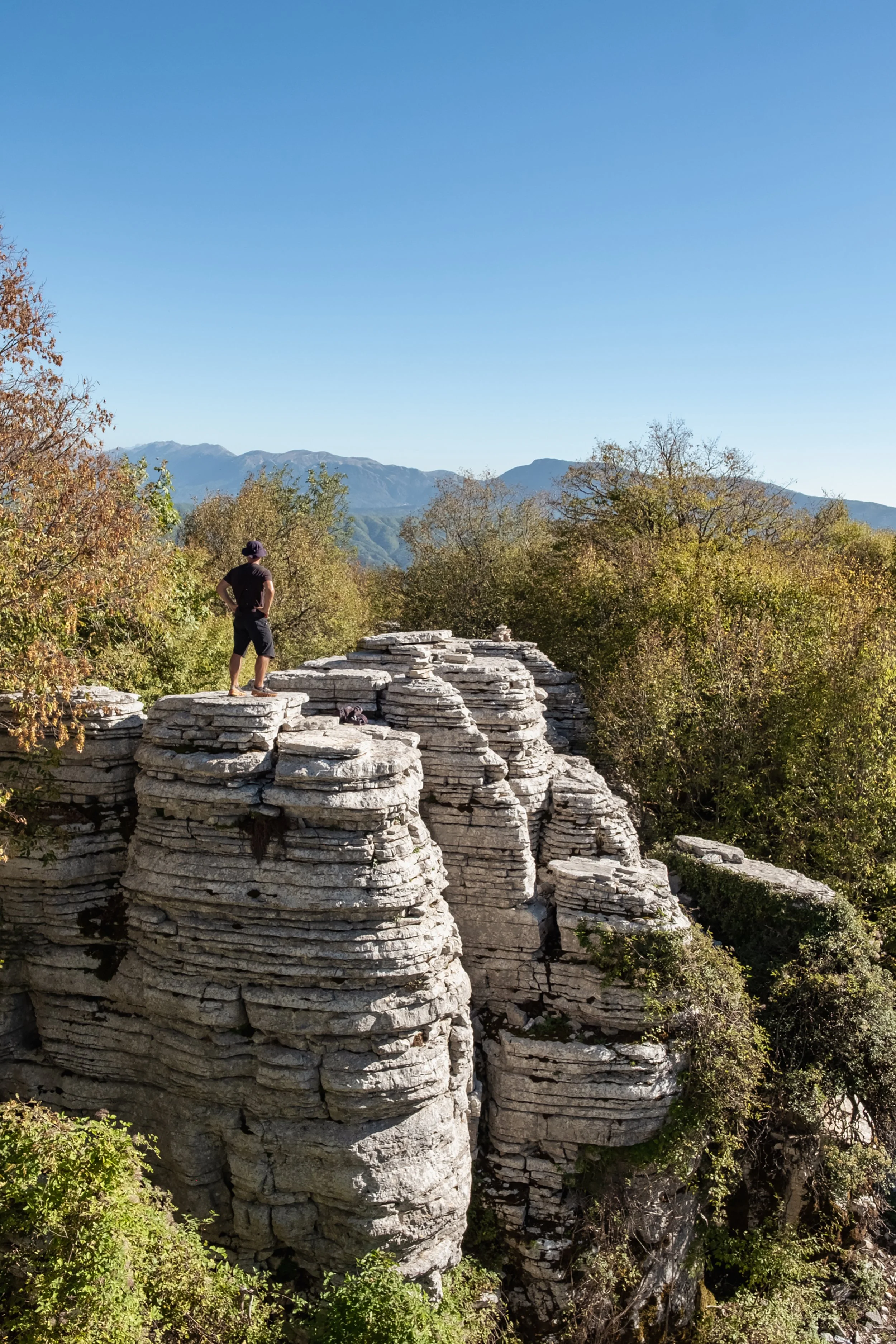
It’s quite the vantage point: all around, thrusting upwards through the densely forested valley floor, are the gargantuan pillars of sandstone rock for which the area is renowned. In places, these are as smooth and uniform as the funnel of a steamship. Others resemble giant shark fins or the horn of an enormous saddle. Geologists explain this wildly anomalous landscape, erupting from the featureless Thessalian plain in north-west Greece, in terms of tectonic movement, vertical fault lines and millions of years of erosive action. But this seems altogether too logical. Too prosaic.
There’s a palpable aura and mysticism to Meteora, one that has made it a beacon of spirituality for more than a millennium. The imprint of this is everywhere, from the hand-chiselled caves of the 11th-century ascetics, some still crosshatched with rickety wooden platforms, to the defunct hermitages secreted into clefts high up in the rock faces. Here, until the advent of organised monasticism six centuries ago, hermits would pass lifetimes of abject deprivation, glorifying God with their self-denial.
Most conspicuous are the six remaining inhabited monasteries. With a sweep of the head, each is visible from where I sit, clinging to their respective pedestal-top eyries with talons of centuries-old brickwork. The monasteries’ exalted setting – some of the stone pillars are almost 1,800ft high – is borderline miraculous. Fall from these structures, as monks often did during their perilous, devotion-proving construction, and you’d have many moments of tumbling contemplation.
When the celebrated travel writer Patrick Leigh Fermor visited in the 1950s, he found the monasteries of Meteora in a wretched state. “Some of the doors of the empty cells [hung] open. Others were closed with twists of wire, and last year’s leaves blew about the wide wooden halls,” he wrote.
Today, supported by the yield of a carefully managed visitor programme, they’re immaculate, with robust walls and red roof tiles that glow like the embers of the day. “What you must appreciate about Meteora,” local guide and historian Vasilis Kiritsis, tells me, “is that this is a place where both nature and mankind are at the very top of their creative games.”