Images: John BurchamRunner’s World | October 2025
Into the void
With wildly fluctuating temperatures, punishing verticality and brushes with mountain lions, the Grand Canyon’s Rim to Rim to Rim endurance run is not for the faint-hearted
“It’s a doozy alright,” says the receptionist, fixing her eyes on the snow storm battering the hotel window. “We’ve had guests calling up all afternoon saying they won’t be able to make it here as the interstate has been shut. Some may even end up having to sleep in their cars.”
The flurry of cancellations explains the Shining-like dearth of guests here at The Grand Hotel, in Tusayan – the gateway town for the Grand Canyon. A huge fire blazes away in the lobby, casting a welcoming glow on the oversized sofas and wall-mounted moose and elk heads. There’s coffee on tap, a hot tub in the spa and an on-site saloon and steakhouse in which to linger.
It’s the perfect place to lie low until the storm passes. The only problem is, in just a few short hours, I must prise myself away from this timber-clad sanctuary to tackle one of the world’s most spectacular and challenging endurance runs.
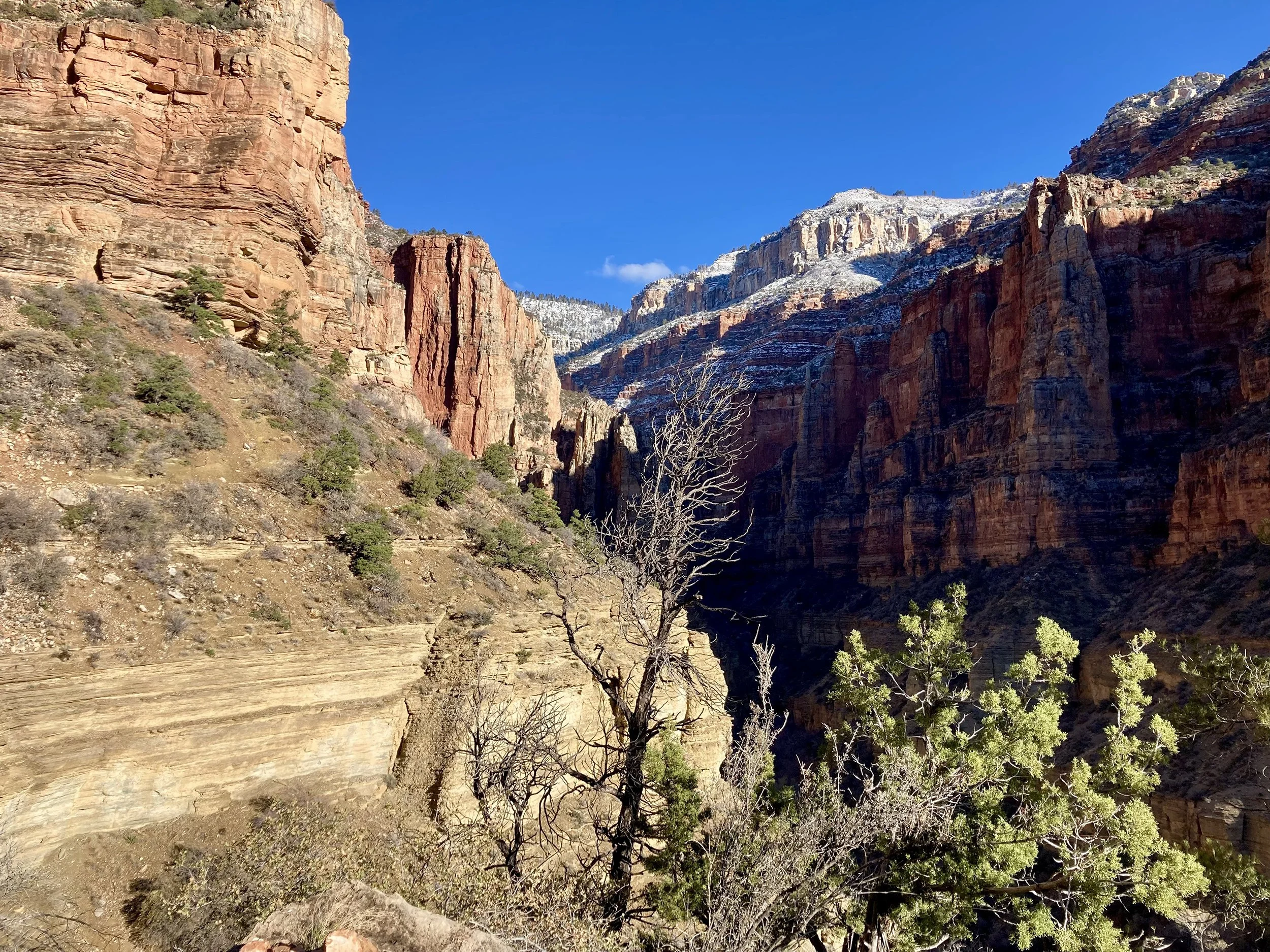
Rim to Rim to Rim (known in ultra circles as ‘R2R2R’ or simply ‘R3’) is an undertaking that even in benign conditions is borderline barbaric. The challenge has a childlike simplicity to it: “I wonder how long it would take to run to there and back.” ‘There’ is the opposite rim of a canyon so vast you could spend decades scouring its depths: 446km long; 29km across at its widest point; and plummeting a rusty-red, strata-laced vertical mile.
As I’m shortly to discover, you can be shivering in -13C on the rim in thick snow, and a few hours later – dusty, sweat-encrusted and parched – running across the canyon floor doing a nervous mental stocktake of your electrolyte supplies.
The wildly fluctuating temperatures are just one of the challenges. The 68km length of the run, another – laced, unsurprisingly, with some head-spinning ‘vert'. Make it back to your starting point on whichever rim you begin and you’ll have tackled an aggregate of around 3,700m up, and the same down.
Then there’s the self-sufficiency. Drinking-water ‘spigots’ are dotted along the South Kaibab and North Kaibab trails – the most common route that R3 runners follow. But they operate intermittently (all but one was shut off during my attempt in early March). And pretty much your only option for replenishing food supplies is the century-old Phantom Ranch, on the North Kaibab, which is the only lodging on the canyon floor. Again, my luck would prove to be out: ‘Closed for excavation work.’
To spice things up further, there are the sheer drops and shoulder-width narrowness of the trail in places, the football-sized rocks you’ll inadvertently/wincingly punt down the trail – and the outside chance of an encounter with the Grand Canyon’s largest carnivore.
During his Fastest Known Time (FKT) attempt in 2016, Jim Walmsley’s headtorch beam picked out a mountain lion around 50 yards ahead of him in the narrow box-canyon section along Bright Angel Creek, around nine miles in. “It was a complete fight-or-flight moment,” the Flagstaff-based ultrarunner and 2023 Ultra-Trail du Mont-Blanc winner wrote in his subsequent report. “I started shouting at the top of my lungs … while running full speed at it.” The lion – as with the rest of the species, far more partial to elk or deer than salty, sinewy snacks – leapt up the cliff wall and was gone.
So, all things considered, a beast of a challenge – yet one that had intrigued me for the best part of a decade, ever since reading of Walmsley’s bid to take the FKT from fellow Flagstaffian Rob Krar. When he managed it, excited reports were complemented by a stirring film which immediately and indelibly inked R3 onto my running bucket list.
Shot by video producer and fellow endurance runner Jamil Coury, it follows the first couple of miles of Walmsley’s descent from the North Kaibab trailhead, the FKT for the fastest single crossing of the canyon already in the bag. To a serene soundtrack by Swedish electronic artist Cope, he descends the slender path in dazzling, early-morning Arizonan sunlight, switchbacking down the forested slope as the gaping, five-million-year-old chasm opens up beneath him.
Walmsley’s not running; he’s gliding – “rolling”, as he calls it. This would have been the most pleasurable stretch of his R3, for sure (a soundtrack of Wagner would be more suited to the segments of relentless climb), and he’s one of the very best in the world at what he does. But it made no difference: I was hooked. This, I decided, was an arena for me.
The FKT that Walmsley set, on a perfect autumnal day nine years ago, was 5 hours 55 mins and 20 seconds. It seemed implausible then; knowing what I know now, it’s beyond comprehension. The consensus from the various veterans I speak to pre-attempt is that peak-fitness, assiduously prepared runners would hope to finish in roughly double that. Which was going to mean a heinously early start if I was going to ensure a buffer of daylight, lest I become an abject epilogue in cult local misadventure book, Death in Grand Canyon.
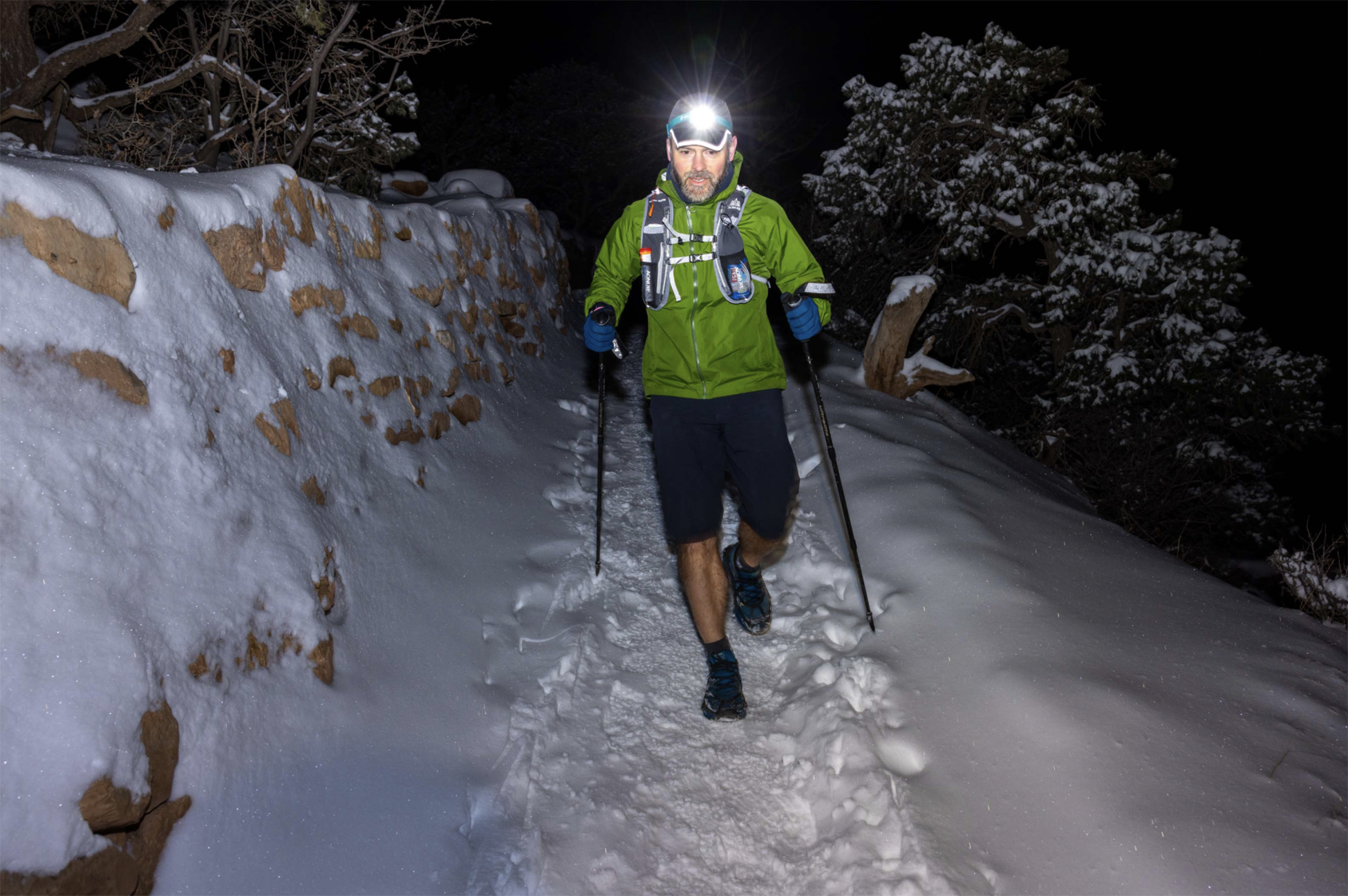
So, with the snow storm having blown through, leaving a Siberian wind-chill and more than half a metre of accumulation in its wake, I depart the hotel at 3.15am, drive to the South Rim, attach my Yaktrax ice grips to my trail shoes and peer into the abyss.
“The blackness before me left a knot in my throat,” wrote Rob Krar, describing his then-record-breaking attempt in 2013. “The Canyon, each time, demands your respect.” I turn on my headtorch, gulp down a last mouthful of trail mix, and set off down the steep, snow-banked trail into the all-consuming gloom