Images: Matt Champlin/Getty; homepage - Jack Barnes/National Geographic
The Sunday Times | February 2019
Archaeological Fiennes
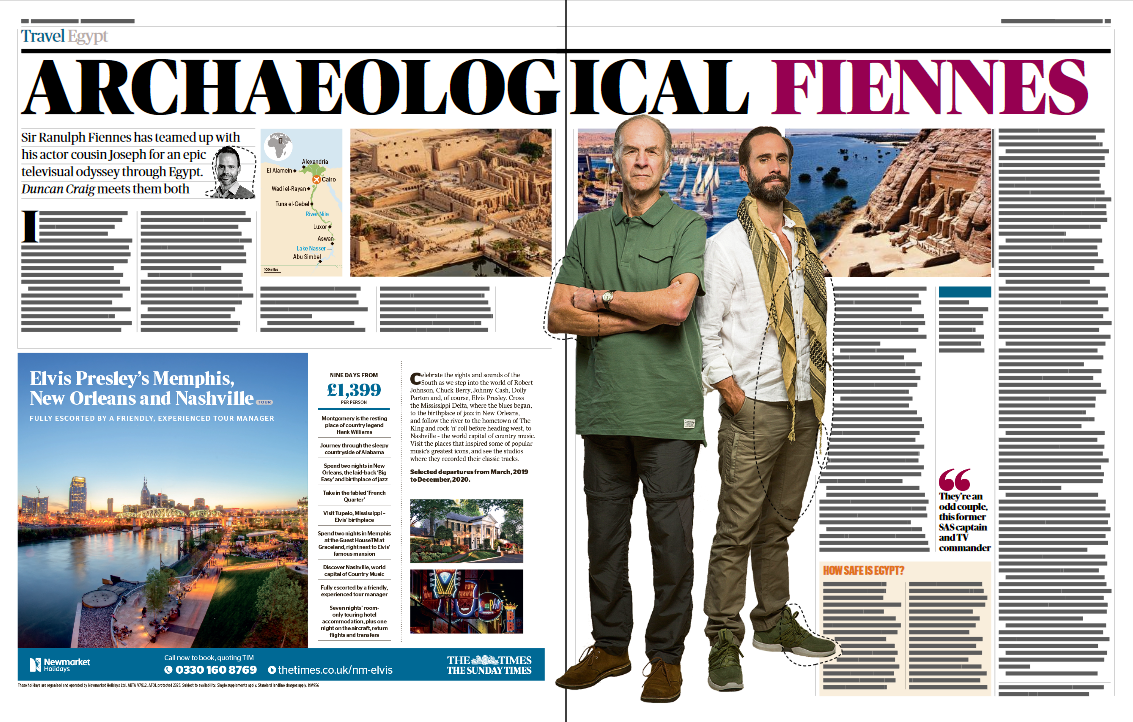
Two luminaries of the Fiennes dynasty, polished actor Joseph and grizzled explorer Ranulph, have teamed up for a TV series about Egypt. Duncan Craig meets the unlikely pair
I am sitting in a smart hotel suite in Soho with a brace of Fienneses. One’s in his element: pocket square, manicured beard, slicked-back hair, easy smile. This is Joseph, the Emmy- and Bafta-nominated actor. The other wears a well-worn fleece and has a watchful manner: Sir Ranulph Fiennes, the world’s greatest living explorer. Trendy suites, it’s manifestly apparent, are not his natural domain.
They’re here — I’m here — to talk about an unexpected collaboration between these markedly disparate cousins. Fiennes: Return to the Nile is a three-part National Geographic programme in which the pair mark the 50th anniversary of Ran’s first significant expedition by returning to Egypt. The 1969 adventure took him and his group from the port city of Alexandria, on the Mediterranean coast, along the course of much of the Nile, all the way down through Sudan and Uganda to Lake Victoria. They covered about 4,000 miles in total, much of it in a couple of beaten-up Land Rovers, one bought with Ran’s life savings.
The SAS captain never looked back, going on to become the first person to cross both polar icecaps and climb the highest mountains on each continent, and amassing a string of feats and records.
Interviewing him, it’s impossible to take one’s eyes off the bulbous, foreshortened fingers of his left hand, a legacy of severe frostbite picked up during one of his North Pole missions. He took a hacksaw and sawed off the tips. (He keeps them in a little tube at home, like gnarly old cashews, as we see in the programme.)
The return to Egypt is somewhat different. For one thing, the route takes them only as far as the ancient temples at Abu Simbel, near the Sudanese border. It’s also more meandering: the battle site of El Alamein, where Ran’s revered father fought; Wadi el-Rayan, in the immeasurably vast Western Desert; the necropolis of Tuna el-Gebel, in Al Minya; Cairo, Luxor, Aswan, Lake Nasser. “When we did it 50 years ago, we were in such a hurry,” Ran says. “We didn’t stop to see any of these wonderful things. Because we were on leave, we had to get back to the army. So, for me, to have this opportunity was just sent from heaven. I missed out 50 years ago.”
And this time his cousin is in tow — Bafta-nominated for Shakespeare in Love, in 1999, and better known these days as the terrifyingly taciturn Commander Fred Waterford in the television series The Handmaid’s Tale.
Joe is here, he tells us in the narrated introduction to the opening episode, to get to know Ran — “a man whose story is more extraordinary than any role I could play”. The man behind the myth. He confesses he barely knew his celebrated cousin prior to their joint adventure, testimony to Ran’s half a century of global conquest. Joe’s second goal? To “test myself, to push myself to certain limits — to see where my cutoff point is”, he tells me.