
Images: Alex Davidson; homepage - Cameron SpencerRunner’s World | May 2025
Double Dutch?
As the refreshingly unconventional Sifan Hassan returns to the London Marathon, can we expect yet another shining moment from one of running’s brightest stars?
Picking out the defining moment of Sifan Hassan’s career is an infuriating exercise. The challenge is not in finding a contender, of course – it’s in settling on the preeminent one. The charismatic distance runner with the monopolistic tendencies has achieved more titles, medals and records to date (she’s still only 32) than half a dozen elite athletes might hope to collectively flaunt in their dotage. Yet her progress has been anything but smooth and linear, often by design – and the result has been a carousel of compelling moments.
There was the tumbling fall in the final lap of the 1,500m in the Tokyo Olympics. Sure, the race was a heat, but the way she rejoined the race and proceeded to reel in every single one of the field to take the most improbable of wins was redolent of a generational F1 driver in a controversially superior car. It somehow didn’t seem fair. A few hours later, showing scant signs of fatigue, the Dutchwoman was winning the first of her six Olympic medals.
Or what about another fall, this time within touching distance of the finish line in the World Championships in Budapest in 2023? Winding it up down the final straight in the 10,000m, she clipped a leg, slid painfully and had to watch as three athletes from the country of her birth – Gudaf Tsegay, Letesenbet Gidey and Ejgayehu Taye – claimed a podium clean sweep for Ethiopia. Gidey later won the Fair Play Award at the World Athletics Awards for going back to console Hassan. Many felt it should have gone to Hassan herself, who rather than throwing a Trumpian-grade wobbly and challenging the result, got to her feet and strolled resignedly across the line with blood oozing from a deep gash on her elbow but her trademark smile still in place.
“This is sport, these things happen,” she later said. “I just had a bad moment.”
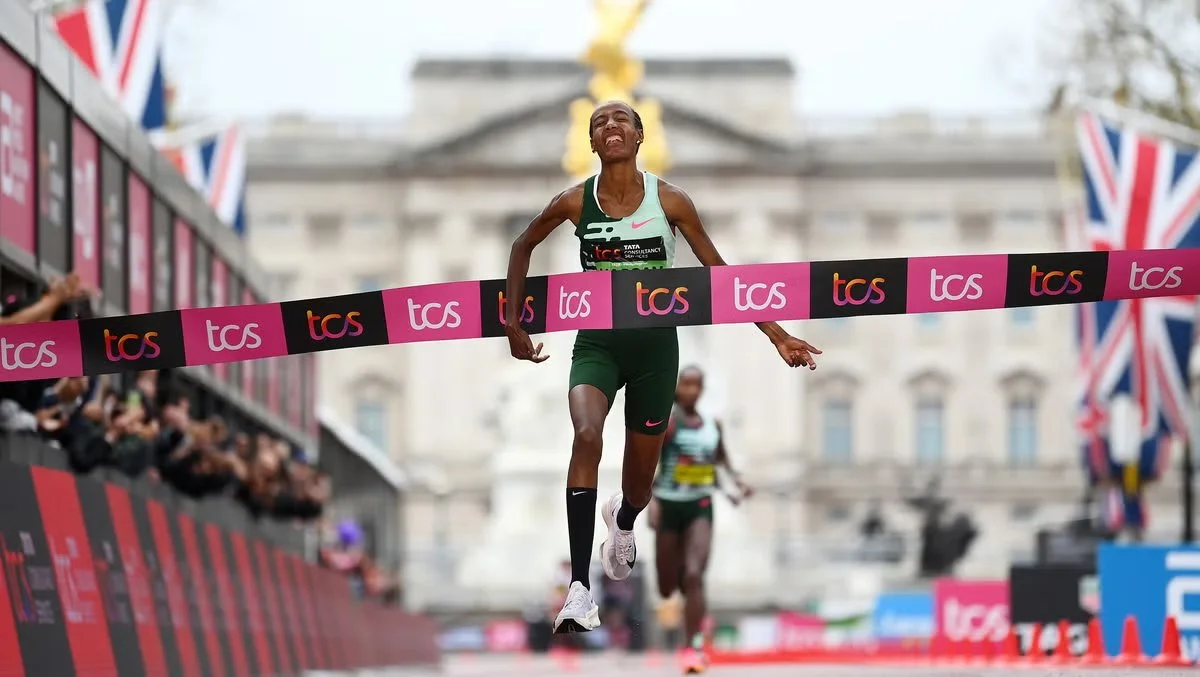
Others might point to Hassan’s debut marathon victory – indeed her debut marathon – in London in 2023. It was as chaotic as it was mesmerising. Up against arguably the strongest female line-up in history, led by then world record holder Brigid Kosgei and Olympic champion Peres Jepchirchir, she provided a masterclass in how not to run the event at the highest level.
She forgot to ask her physio to tape up an injured leg. She stopped twice to stretch. Later, she nearly missed a drinks station – veering across the road sharply and narrowly avoiding a collision with a support motorbike – then offered the poker-faced defending champion Yalemzerf Yehualaw a sup of her drink. She looked like a callow novice, which, in fairness, was no act. Steve Cram and Paula Radcliffe, providing the commentary, even seemed to suggest at one point that – bless her – it might be better if she threw in the towel. But that’s not really the Hassan way, and shortly afterwards she was racing down the Mall to a plausibility-stretching maiden win, which she backed up six months later on the streets of Chicago.
Last year threw up what, in time, may come to settle the “defining moment” conundrum once and for all: Hassan’s battling, courageous victory in the Paris Olympics marathon. The course was harder and hillier than any before it, with more elevation than the Boston and New York courses combined. Just 37 hours prior, Hassan had raced the energy-sapping 10,000m final, claiming bronze. And in Tigst Assefa she was facing an opponent who simply wasn’t going to countenance defeat.
It was to come down to a ferocious final sprint for glory, culminating in a “coming together” (rarely has that genteel athletics euphemism seemed more laughable). Veteran Getty photographer Michael Steele was perfectly placed to capture the elbow-flailing, sinew-straining moment. His image of Assefa and Hassan – airborne, like thoroughbreds in full-flow, with a sea of camera phones closing in around them – rightfully won Photograph of the Year at the World Athletics Awards.
“I’ve actually got that shot on my phone,” Hassan tells me, when I raise it. “I just can’t bear to look at it.” Like a straight-A*s A-Level student waking up in a sweat months after the exams, there’s still a visceral terror that the win may not, in fact, be real. Or perhaps that it will be wrenched away with another stumble or – as it nearly was – an obstruction appeal. “I’ve watched it [the final stages of the race] back so many times and, every time, I’m so scared. It panics me. Even when I passed her [Assefa], I wasn’t sure I had the victory. I was telling myself just relax and breathe, get across the line. But I was thinking ‘oh my god!’. I wanted it so much.” The terror propelled her to an Olympic record as well as gold. The sweetest win of her career? “Yes, I think so.”
Chatting on a miserable January morning, with rain lashing against the window of her agent’s office in the Netherlands, that balmy August day in Paris feels a long way off. The self-confessed “nomad”, who spends large chunks of her year in America and Ethiopia these days, is enjoying a brief moment of respite and reflection in northern Europe – and seems grateful for it.
She’s “chilled”, to use a Hassanism, enthusiastic (when is she ever not?), scrupulously polite and, as I’m to find out over the subsequent hour or so, customarily loquacious. Hassan speaks fast and without a filter; she’s impulsive and charmingly digressional. She’d be a nightmare in team sports, I decide. But she’s an interviewer’s delight, consistently eschewing athletese, the guarded, content-free language a la mode.

Image: BSR Agency