
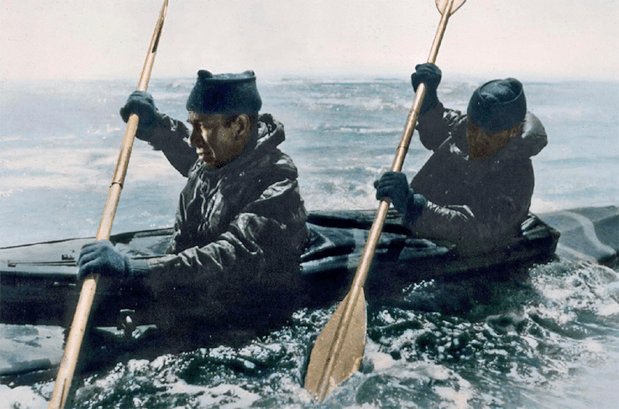
A scene from 1955 film ‘The Cockleshell Heroes’ © AlamyFinancial Times | December 2024
Across Bordeaux in the footsteps of France’s most daring wartime raid
In December 1942, a group of commandos set out on an audacious raid – from which most would not return. Duncan Craig joins the Frankton Trail
IT’S mid-afternoon, mid-summer, and an air of contented indolence has descended across the coastal hamlet of Montalivet in western France. High-altitude cirrus smudges a sky of inky blue, and the squeaky sands of the vast Cote d’Argent effortlessly absorb the high-season crowds.
Sitting outside a cafe in the shade of the pines is a group of young holidaying Britons. They chat happily as they sip their iced coffees and stare out at a lethargic Atlantic.
Just a few kilometres from where they sit, exactly 81 years ago, a similarly youthful group also arrived here from across the Channel. But a beach break was the very last thing on their minds. The 10 young men had been tasked with a clandestine commando raid so emblematic it would spawn its own special forces unit; so consequential that, in British Prime Minister Winston Churchill’s words, it shortened the Second World War by up to six months; and so dangerous that only two of them would make it home alive.
From the puddled deck of submarine HMS Tuna, emerging from the depths off Montalivet, the men – members of the Royal Marines’ embryonic Boom Patrol Detachment, later the Special Boat Service – silently launched five two-man canoes. Their mission? To paddle up the Gironde Estuary and deep into German-occupied France to place mines on enemy shipping docked in Bordeaux – and blow a hole in the occupier’s growing sense of its own invincibility.
Operation Frankton was tantamount to a suicide mission. The strategically vital estuary was absurdly heavily guarded. Bordeaux lay 100km upstream, necessitating multiple days – or rather nights – paddling their canvas and plywood ‘Cockles’. And should they succeed, their tellingly vague ‘extraction plan’ was to trek a similar distance overland to a nondescript rural town from where the French Resistance would attempt to assist them.
It is to trace this extraction route – now a hiking and cycling trail named after the operation – that I’ve come to the Gironde Estuary. But before I do, I’ve improvised my own trail that takes in key spots through which the daring commandos passed on this remarkable mission.
Set back from Montalivet beach, beneath a tricolore flapping audibly in the breeze, stands a smart, white-stone memorial to Frankton. It details the earliest hours of the mission, and the men involved – led by Major Herbert “Blondie” Hasler, the Dublin-born, exuberantly moustached catalyst of the enterprise.
At a little before 8.30pm on Monday December 7th 1942, HMS Tuna slipped beneath the waves and Hasler and his amphibious squad, their faces blacked out and hearts thumping, set a course for the mouth of the estuary, some 16km up the coast. At that moment, pretty much all that the 10 Royal Marines had going for them was a quality lionised by the greatest military leader of the country into which they now paddled.
“In war,” Napoleon once asserted, “the finest calculation of genius is audacity”.

