
Images: Dafydd Jones
Delayed Gratification | October 2023
The art of living dangerously
In October David Kirke, the anarchic buccaneer who performed the world’s first bungee jump and a host of other madcap stunts, died in Oxford at the age of 78. His friends remember a flamboyant but flawed force of nature
“David lived by an entirely different set of rules to most people,” says Hugo Spowers, a leading figure in the Dangerous Sports Club (DSC) that David Kirke established in the late 1970s. “Some of them were admirable. An awful lot of them weren’t.”
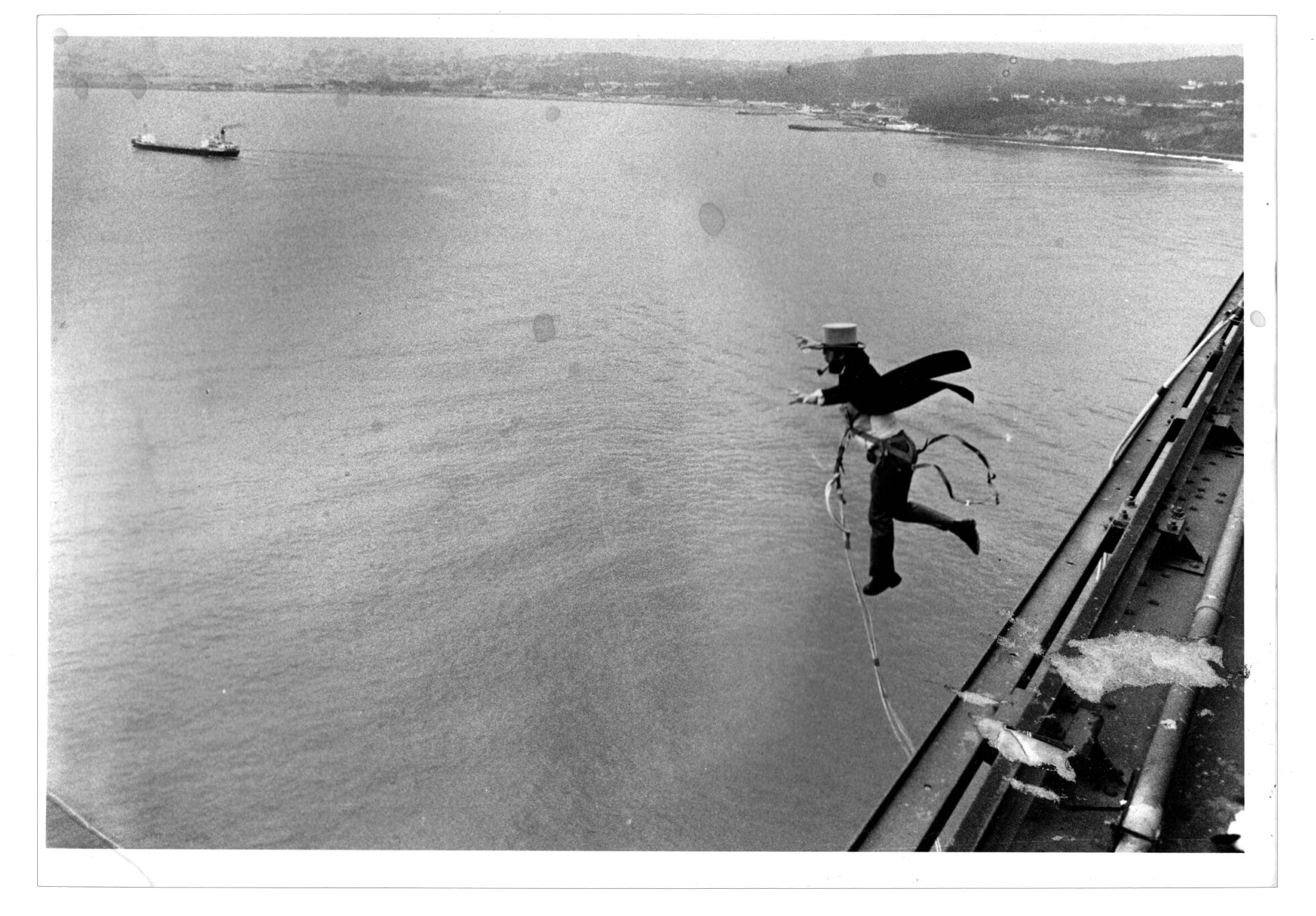
It was dawn on April Fool’s Day 1979 when Kirke and three fellow members of the Oxford-based club hurled themselves off the 245ft-high Clifton Suspension Bridge in Bristol. Inspired by the little-known Pacific Islands ritual of “land diving” using vines attached to bamboo towers, the quartet – running on the fumes of an all-night party – had elasticated cords tied to their midriffs. Kirke, the first to leap, was dressed in top hat and tails and clutched in his hand a bottle of Bollinger.
“There wasn’t a moment's hesitation – there never was with David. He did it with great style and bravado,” says Spowers, 64. “There was no test run beforehand or anything. That would have been anathema to the whole spirit of the club.”
Kirke and his fellow jumpers – Tim Hunt, brother of legendary racing driver James, among them – were charged with breach of the peace, fined £50 each and locked up for the day by police, who were sufficiently impressed to let them finish their half-drunk bottles in their cells. “We want to trigger a worldwide craze,” the broad, bearded Kirke, then 33, told reporters as he was led away from the bridge after being hauled back up.
That was exactly what he achieved, says Spowers – who was inspired by the stunt to join the DSC and commit wholeheartedly to its jump-first-ask-questions-later ethos. The club had been founded two years earlier after Kirke and his Oxford University contemporary Ed Hulton visited the Swiss Alps to experience the fabled Cresta toboggan run. “They decided it really was not very dangerous and was just full of wealthy Germans showing off to their mistresses,” says Spowers.
Interest in the DSC ballooned off the back of the Clifton bungee jump – but the club resisted the temptation towards anything as conformist as organisation. “There was no such thing as membership; you just gradually got absorbed,” recalls Spowers. “If you knew what was going on and were invited to come along, you were probably a member. If you didn't, you weren’t.”
Spowers knew he’d made the grade when he was invited by Kirke to Beachy Head, in East Sussex – one of Britain’s highest sea cliffs at 530ft – in 1980. “It was the first attempt at ‘looning’ – attaching a small number of 10ft-diameter balloons to your harness,” remembers Spowers. “We got there about 6.30am but it was very, very windy, so we didn't really gravitate beyond the cafe. It probably had some alcoholic beverages. It was an abortive attempt.”
But Kirke et al – who in 1978 had sailed for five days through Force 9 gales for a drinks party on the wave-lashed North Atlantic stack of Rockall (“Dancing 6.30pm. Black Tie”, read the formal invitation) – weren’t the sorts to be easily deflected. Over the subsequent decade, the DSC was to breach plenty more peace.
There was the attempt by Kirke to fly a microlight to Paris in 1980. “He crashed into some trees not far from Croydon,” says Spowers. Multiple repeat bungee jumps were performed by club members, everywhere from cranes assembled at country fairs in the UK to San Francisco’s Golden Gate Bridge. In 1986, Kirke finally “looned” his way across the Channel, on a kangaroo-shaped cluster of helium balloons. Foster’s lager was cajoled into sponsoring the madcappery.
Some of the most enduring DSC images, however, stemmed from an idea dreamt up by Spowers and fellow member Tommy Leigh-Pemberton in the early 1980s. “Over dinner one night we cooked up this idea of having a bicycle race down the Matterhorn with a parascending chute attached to you,” says Spowers, a motorsport engineer and entrepreneur who received an MBE in 2022 for services to technology. “On the shallower bits you were peddling and on the steeper bits you just took off.”
With Kirke’s input this evolved into a sequence of surrealist downhill races in St Moritz featuring the most extravagantly incongruous conveyances that could be hauled up a mountain and placed on skis. A carousel horse. An Oxford punt. A 2CV. Even a grand piano.
Inevitably, given the frequency and ambition of the exploits, there were injuries. Kirke’s own luck ran out in 1989, towards the end of the club’s lifespan, when he fractured his spine in three places after a stunt in which he was catapulted into the Atlantic from the Cliffs of Moher, in Ireland, by a device used to launch military drones. “A special seat that would have distributed the load around his body when he was hurled at 20-plus G wasn’t available in the end,” recalls Spowers. “He was determined to go ahead regardless so just strapped himself in with a bit of foam and sticky tape.”
But it was Spowers himself who had the closest brush with death. It came when he calamitously miscalculated the length of rope during a bungee jump display at a festival in Towcester, Northamptonshire, in July 1983. “I would have gone down another 40ft if the ground hadn’t got in the way. I broke my back twice, my neck twice, my pelvis twice, 10 teeth,” he says. “I later heard there were seven insurance claims for shock and all the loos were blocked from people being sick. That’s the worst injury that the DSC ever had – a few members are no longer with us but they didn’t die in DSC activities.”
Given the nature of the undertakings, it’s little surprise that restraint wasn’t exactly the defining quality of the club’s pre- and post-event carousing. “I suppose you’d have to class it as hedonistic,” says Spowers, almost self-consciously. But the ethos, he points out, was always more libertarian than boorish, with a commitment to the overarching cause that went far beyond chandelier-swinging debauchery. “Certainly none of the hedonism would have existed without the core focus of the club,” says Spowers. “It was a much richer cocktail than that.”

Dafydd Jones